

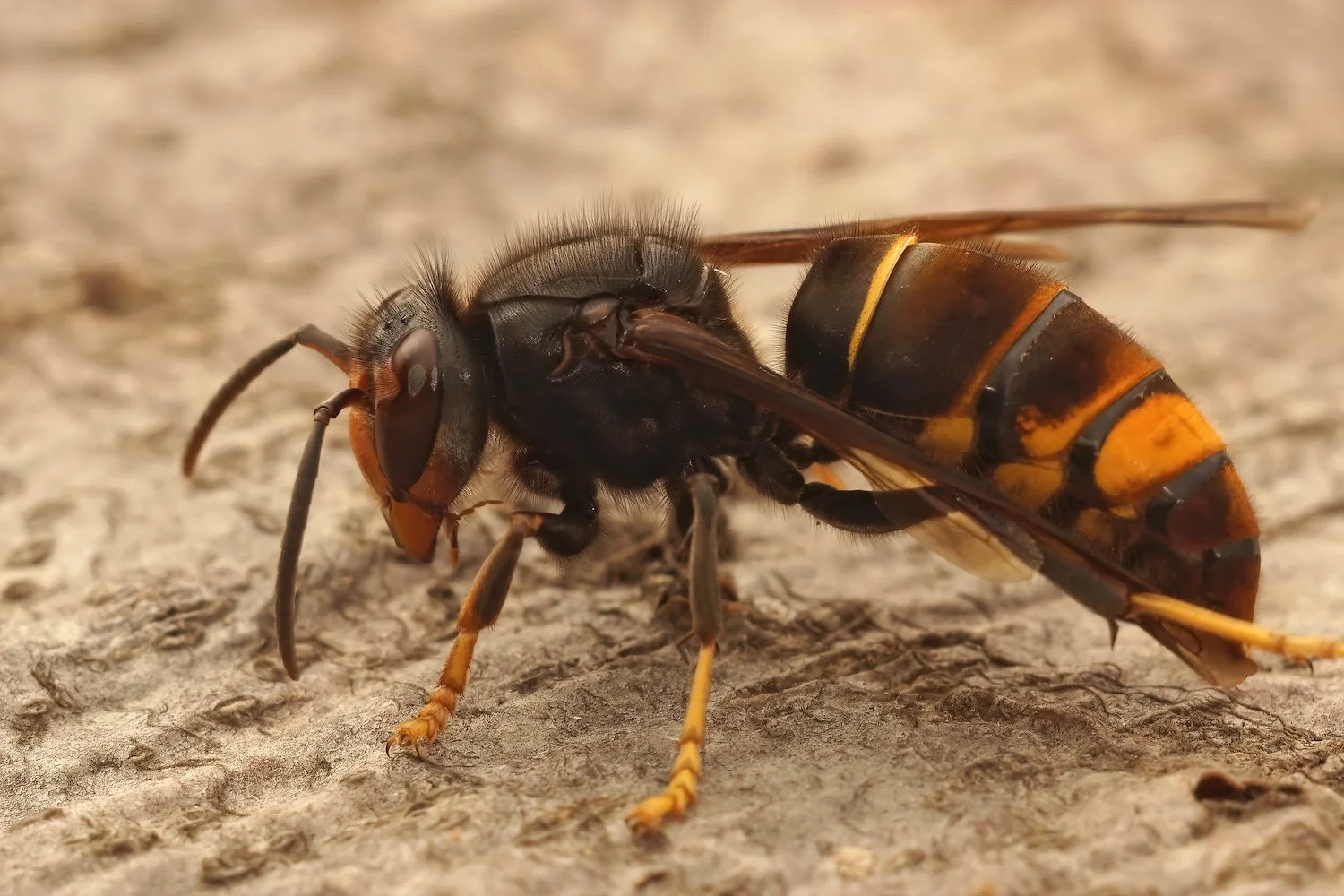
Click on the photo for Clemson’s helpful identification guide.
We recently published a short post flagging the yellow-legged hornet's spread across the Lowcountry. That post was meant as a heads-up. This article is the deeper look into the situation actually calls for, because the story has quickly moved from "emerging concern" to established fact. The invasive hornet has spread well beyond the original foothold near Bluffton, and now stands as a fixture across much of the Lowcountry.
At The Charleston Arborist, hornets aren't a side topic for us. Nest removal from live trees sits at the intersection of two things we do every day: assessing what's happening in the canopy, and working safely at height. This guide takes a deeper look at where things stand, explains why the nesting habits of this particular hornet turn the situation into an arborist's problem, and lays out what property owners in our service area should actually do in response.
A Quick Recap: What Is the Yellow-Legged Hornet?
The yellow-legged hornet (Vespa velutina) is a large, aggressive predatory wasp native to Southeast Asia. The species reached Europe through the port of Bordeaux around 2004 and has since spread across most of the continent, hammering honeybee populations along the way. First confirmed in the continental United States near Savannah, GA, in August 2023, most likely after hitchhiking on cargo shipping, the hornet turned up in the Bluffton area of the Lowcountry by November of that year.
A few identification basics worth knowing:
Size: Workers run close to an inch long, noticeably bigger than a yellow jacket, roughly comparable to a European hornet.
Coloring: A mostly black-brown body, a dark abdomen with one broad orange-yellow band near the tip, and an orange face.
The giveaway feature: Yellow tips on all six legs, the "tarsi", the source of the common name. A clear look at the legs offers the most reliable field mark.
Look-alikes: The native European hornet and native bald-faced hornet are both commonly mistaken for the yellow-legged hornet, and both are far more common, so a big hornet in your yard is not automatically cause for alarm. Worth a photo and a second look before assuming the worst.
Unlike the so-called "murder hornet" (the northern giant hornet that appeared briefly in Washington State and was eradicated there), the yellow-legged hornet isn't more dangerous to people than the wasps you already deal with every summer. The sting isn't unusually painful, and the hornet isn't especially aggressive toward humans unless a nest is disturbed. The real danger is to honeybees and other pollinators. And by extension, to the pollination that regional agriculture depends on.
How They're Spreading
The short version: far and quickly.
The Lowcountry's confirmed range now stretches across Beaufort, Jasper, Colleton, Charleston, Dorchester, and Hampton counties, with Clemson's Department of Plant Industry running the statewide response.
And the hornet has jumped well outside the Lowcountry. A confirmed nest in York County, near Charlotte, marked the first detection outside the coastal region, and reports have since prompted heightened monitoring across the Upstate.
The yellow-legged hornet has now been documented crossing into North Carolina, with detections reported in counties near Charlotte and the Piedmont as of this year, a sign the insect is moving up the I-95/I-26 corridor about as fast as officials feared.
South Carolina has removed well over 300 nests so far this year alone, and Clemson's team has now deployed thousands of monitoring traps statewide, with well over 9,000 trap checks completed.
Local beekeepers on Hilton Head and elsewhere in the Lowcountry describe honeybee colonies effectively under siege with the hornets "hawking" outside hive entrances, picking off returning foragers, and hollowing out the thorax of each bee to feed their brood. Some keepers report losing multiple colonies outright.
None of that suggests a pest on the way out. The numbers point instead to a pest well suited to the Lowcountry's climate, tree cover, and abundant honeybee population, one likely to become a fixture from Charleston to the Upstate before long.
Why This Is an Arborist's Problem
Here's the piece that doesn't always show up in the news coverage: yellow-legged hornets are overwhelmingly tree-nesters.
Early in the season, a mated queen builds a small "embryo" nest, often low, sometimes in a shed, a shrub, or even a water meter box, to get her first batch of workers going. Once that first generation of workers takes over construction, the colony typically relocates or rebuilds into a much larger "secondary" nest, and this is where trees come in. Secondary nests are commonly built:
High in the canopy of large trees, anywhere from roughly 6 feet up to well over 60 feet. Clemson crews have documented nests near 60 feet in live oaks and other large hardwoods.
In sheltered, hard-to-see spots: dense canopy, cavities, eaves, and rooflines that mimic the shelter a hollow tree would provide.
At a scale that's easy to underestimate from the ground. By late summer, a secondary nest can grow from basketball-sized to the size of a large beach ball or yoga ball, housing anywhere from several hundred to several thousand hornets.
That combination, high canopy placement, dense foliage that hides the nest until fully grown, and a colony that will defend the nest aggressively once disturbed, is exactly the kind of hazard that calls for someone who already understands tree structure and canopy access, not just pest biology. Assessing or accessing a nest 40 or 50 feet up in a live oak isn't a ladder job. This calls for a rigging, rope-access, or aerial-lift approach, done by people who know how the tree is going to behave under that kind of activity.
This is also exactly why nest discoveries so often happen during routine tree work. A pruning crew, a risk assessment, or a storm-damage inspection is often the first time anyone gets eyes-level with the upper canopy where these nests hide. Property owners who wait for a hornet problem to become visible from the ground are, in effect, waiting for the nest to already be huge.
What Not to Do
State officials have been consistent on this point, and we echo the same advice: do not attempt to remove a suspected yellow-legged hornet nest yourself. Secondary nests can hold thousands of hornets, they defend aggressively when disturbed, and, critically, most are located well above what a homeowner can safely reach or see clearly. Amateur attempts (long-range wasp spray, fire, knocking a nest down) tend to either fail outright or scatter an angry, established colony rather than eliminate the threat.
What To Do Instead
Get a photo if you can do so safely, from a distance. The yellow legs and orange face are the details that matter most.
Report the sighting. Clemson's Department of Plant Industry maintains a statewide Yellow-legged Hornet Reporting Tool built specifically for this. Reports from areas without confirmed activity are especially valuable to the response team, since they help catch new spread early.
Don't disturb the nest or the surrounding area while waiting for Clemson's response team to assess the situation.
If the nest sits up in a tree, which is usually the case, a canopy-level look matters too. Knowing whether the branch or cavity holding the nest is structurally sound, and how to reach the area safely, is a separate piece of the puzzle that Clemson's team may not always have eyes on until they arrive.
Where The Charleston Arborist Comes In
This is the piece of the yellow-legged hornet story that's specific to us. We're not the ones who determine whether a nest is a positive ID or a look-alike, and identification, removal, and elimination are handled by Clemson's Department of Plant Industry response team, not by us. What we bring to a hornet call is everything on the tree side of the situation:
Canopy-level eyes. Our crews are already up in trees for pruning, risk assessment, and storm cleanup across the Lowcountry, which means we're often the first ones in a position to spot a secondary nest before the nest becomes obvious from the ground.
Safe access support. If a nest sits 40-plus feet up in a live oak, getting eyes on the nest safely, without disturbing the colony prematurely or damaging the tree, is a rigging and canopy-access question. That's our specialty, and we can support Clemson's team with that access when useful.
A structural read on the tree in question. A nest built in a cavity or a weak union isn't just a pest issue; the location can point to a structural issue in the tree that's worth addressing separately.
Local knowledge of where these nests turn up. Given how much of our work is in the same large hardwoods, live oaks, water oaks, magnolias that this hornet favors, we're tracking activity across our client base as the range keeps expanding north and east from Beaufort County.
If you have large trees on your property anywhere in the Charleston area, a seasonal canopy inspection is one of the best ways to catch a nest while still small, rather than once fully grown to the size of a beach ball. If you've already spotted something matching this description, report the sighting to Clemson's Department of Plant Industry by clicking here.
Separately, if you'd like a canopy-level look at your trees for structural issues or nest activity in general, that's a service we're glad to provide.